6.5 Compressed Air Systems
While an important energy consumer in industrial facilities, compressed air systems are also found in buildings, for example to supply air to pneumatic control systems. Compressed air is an expensive utility, and it is rare that enough attention is paid to the maintenance that these systems require. As typical compressed air system efficiencies range from 5 to 20 % the cost of energy in the form of compressed is at least 5 times that of electricity. Small changes to the systems can provide large savings opportunities with quick payback periods.
With the high cost of the delivered energy form, actions to reduce the end-use are most important. For this reason, reduction in air leakage is the number one priority. Ironically, leaks may consume from 10 to 35% of a system’s capacity for air delivery. Reduction in air leakage translates directly to savings in electricity to the compressor.
6.5.1. Efficiency Strategy
Operational actions are by far the most cost effective opportunities in these systems. A simple strategy with four categories of actions would be:
1. Reduce leaks.
2. Manage end-use:
- Ensure that the end-use is appropriate,
- Ensure that appliances operate at correct pressure,
- Use properly engineered nozzles where appropriate,
- Valve off equipment when not in use,
- Only use dry air when and where necessary.
3. Minimize pressure drops:
- in the distribution system,
- at the compressors’ intake system,
- avoid unnecessary air dryers.
4. Operate compressors efficiently:
- sequence multiple units to avoid light loading,
- maintain and lubricate.
These actions and more are discussed in detail in the following sections. First a set of questions that may uncover opportunities:
Are you supplying leaks in distribution system/end use?
The amount of energy lost to air leaks is directly proportional to the volume of air leaked.
Is the supply pressure higher than required to overcome pipe loss?
Is the compressor delivering air at a pressure significantly above that of the highest end use requirement? If so, there may be restrictive piping in the distribution system.
Can you reduce the requirement for air?
Is compressed air being used inappropriately? The most common occurrence of this is using air to clean up.
Can compressor inlet pressure be raised?
Are there unnecessary restrictions in the inlet piping, possibly the filter is dirty?
Can compressor inlet temperature be dropped?
Is the inlet air to the compressor outside or inside – cooler air is often available outside.
Is compressor drive system efficient?
For smaller units – are drive belts tight?
Do screw compressors have proper capacity control?
Does the compressor have suction (inlet) throttling or slide valve control?
Suction throttling is highly inefficient at low air flows.
Is storage capacity large enough?
Does the compressor(s) cycle frequently – if so, maybe a larger receiver is necessary.
- Detailed Opportunities
Reduce leaks in air distribution system and at point of use.
A simple test (timing compressor cycles when no air is being used) will determine the magnitude of leaks in the system. By performing the test twice, with and without the appliances connected will show the leakage at the point of use.
Reduce compressed air system pressure
Any reduction in the pressure of air delivered by the compressor will directly yield power savings at the compressor. For example, make sure that if the supply air pressure is 105 psig, that is actually required. If the system is sized properly a reduction of 5-7 psig may be possible.
Reduce compressed air requirements
Compressed air can be a large consumer of electricity. For this reason, a survey of where air is being used can be very useful. Just as a load inventory will uncover wasteful uses of electricity – a compressed air survey can reveal significant opportunities for air consumption reduction and hence electricity savings.
Ensure low inlet restrictions (clean air filter)
By ensuring low inlet air restrictions the compressor requires less power to compress the air.
Reduce inlet air temperature (relocate the intake)
Colder air is denser and thus for each volume compressed allows the compressor to deliver more air. Overall this improves the efficiency of compression, reducing energy consumption.
Provide sequencing control of air compressors
In a multi-compressor installation, sequencing of the compressors to best meet the demand for air will result in a higher overall efficiency. Such a control scheme would attempt to fully load the operating compressors by starting and stopping the various units present.
Use screw compressors with capacity control
Screw compressors without slide valve capacity control operate with very low efficiency when they are operating at partial capacity. A fully unloaded screw compressor with only suction throttling capacity control may consume up to 80% of its full load horsepower. Sequencing of the compressors as described above can avoid operation at partial loads for extended periods.
Consider two stage compression with cooling
Two stage compression is a more efficient method of compressing air, but also costlier from an equipment capital cost standpoint. In some instances, a retrofit may be possible.
- The Cost of Compressed Air Leaks
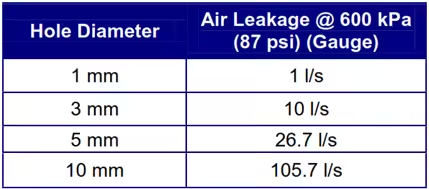
Simplified Air Leakage Test
Step 1. Determine the free air delivery capacity (Q) of your compressor (liters/second).
Step 2. During a time when equipment is connected but not being used on the compressed air system, turn on the compressor and allow it to come up to full pressure.
Step 3. Record the time (t) until the compressor starts again (loads).
Step 4. Record the time (T) until the compressor stops (unloads).
Step 5. Repeat the measurements at least four times.
Step 6. Average the t and T cycles.
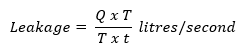
Step 7. Calculate the leakage:
Savings and Payback Calculations
After determining the leakage using the above rate, the cost of these leaks can be calculated:
Leakage Cost (R/Yr.)

Where:
Leakage: Calculated using above test
Q: Delivered air capacity (from nameplate)
Full Load kW: Measured or from nameplate (Volts x Amps x Power Factor x √3 (for 3 phase only)
Operating Time: the hours per year that the compressor is energized (not just the actual time it is running).
Energy Cost: From current electric rates, use second block energy charge.
This calculation will show the annual cost of the leaks. While it would not be possible to eliminate 100% of the leakage, the magnitude of the cost as calculated here will give you some indication of the level of repairs which can be justified on a payback calculation.
Worked Example:
Given:
Q (air delivery capacity) = 236 L/s
Full load nameplate kW = 125 kW
Operating time = 4 022 hrs/yr.
2nd block energy cost = R.25/kWh
Measured:
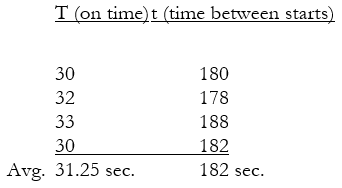
Leakage:
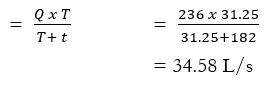
Energy Loss Due to Leakage:

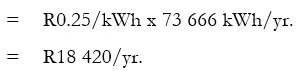
R Lost Due to Leakage: