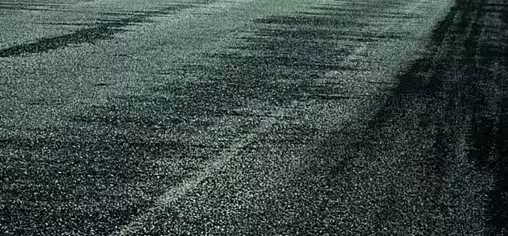
4.4. Item 310 Bituminous Concrete Surface Course, Hot Laid
One of the two basic types of pavement is the “flexible pavement” which is made of compacted mass of mineral aggregate mixed with asphalt laid at a high temperature of about 135oC to 148.89 oC. Aggregates account for 92% to 95% of the weight of the mixture while asphalt accounts for 5% to 8% of the weight of the mix. The exact percentage to be used is established by the “job-mix formula”.
Bitumen is the essential ingredient in practically all flexible pavements. Bitumen is a black or brownish-black amorphous solid which is hard or even brittle when cold. When heated, it gradually softens and then liquefies without any definite melting point.
Each job-mix formula submitted shall propose definite single values for:
- The percentage of aggregate passing each specified sieve size.
- The percentage of bituminous material to be added.
- The temperature of the mixture delivered on the road.
- The kind and percentage of additive to be used.
- The kind and percentage of mineral filler to be used.
After the job-mix is established, all mixture furnished for the project shall conform within the following ranges of tolerances:
- Passing No. 4 and larger sieves ± 7 percent
- Passing No. 8 to No. 100 sieves (inclusive) ± 4 percent
- Passing No. 200 sieve ± 2 percent
- Bituminous Material ± 0.4 percent
- Temperature of Mixture ± 10oC
The mixture shall have a minimum compressive strength of 1.4 MPa (200 psi).
The mixture shall have a mass percent air voids with the range of 3 to 5.
The mixture shall also have an index of retained strength of not less than 70 when tested by AASHTO T 165. For aggregates having maximum sizes over 25 mm (1 inch), AASHTO T 165 will be modified to use 150 mm x 150 mm (6 x 6 inches) cylindrical specimens.
Material Requirements
Composition and Quality of Bituminous Mixture (Job-Mix Formula)
1. Aggregates
2. Mineral Filler
3. Hydrated Lime
4. Bituminous Material
Note: At least 3 weeks prior to production, the contractor shall submit in writing a job-mix formula for each mixture.
Required Minimum Testing Requirements:
a. Aggregates
Tests: For every 75 cu.m. / 200 kg. or fraction thereof:
1 – G, Grading Test
1 – P, Plasticity Test (LIL, PL, PI)
For every 1500 cu.m. or fraction thereof:
1 – Q, Quality Test (Grading, Plasticity and Abrasion, Stripping and Bulk Specific Gravity) 1 – F, Fractured Face
b. Bituminous Materials
Quantity: 5.00 to 8.00 mass % of total dry aggregate
Tests: 1 – Q, Quality Test for every 40 tons or 200 drums
c. Mix
Tests: For every 75 cu.m. / 130 tons or fraction thereof:
1 – G, Grading Test
1 – Ext., Extraction
1 – Sty., Stability
1 – C, Laboratory Compaction
d. Hydrated Lime
Tests: For every 100 tons or fraction thereof:
1 – Q, Quality Test
e. Mineral Filler
Tests: For every 75 cu.m. or fraction thereof:
1 – G & P, Grading and Plasticity Tests (LIL, PL, PI)
f. Compacted Pavement
Tests: For each full day’s operation:
D & T (Density and Thickness Tests) – At least one (1) but not more than three (3) samples shall be taken or 1 per 100 lm per lane
Equipment Requirements
- Asphalt Paver (80 hp), NF220B11VDM
- Pneumatic Tire Roller (10 m.t.)
- Water Truck/Pump (16000 l.)
- Tandem Steel Roller (10.1 m.t.), CC421
- Thermometer
- Dump Truck (10 cu.m. capacity)
- Payloader (1.50 cu.m.), LX80-2C
- Asphalt Batch Plant (60 – 80 tph)
Construction Procedure
- Before placing the bituminous mixture, the existing surface shall be cleaned of loose deleterious materials.
- The Hot-Mix Asphalt (HMA) shall be spread and distribute to the grade and elevation in accordance with the approved plans by means of an Asphalt Paver over the entire width or partial width of the paving surface.
- The longitudinal joint in one (1) layer shall be offset that in the layer immediately below by approximately 15 cm.
- The joint in the top layer shall be at the center line of the pavement if the roadway comprises of 2 lanes.
- Mechanical spreading shall be used on areas with irregularities or unavoidable obstacles.
- Hot Mix Asphalt (HMA) shall be placed at a temperature not less than 107oC.
- After the HMA has been spread, it shall be compacted by rollers.
- Rolling shall begin at the sides and proceeds longitudinally parallel toward the road center line.
- Each trip overlapping ½ the roller width, gradually progressing to the crown of the road.
- For paving in abutting a previously placed lane, the longitudinal joint shall be rolled first followed by the regular rolling procedure.
- For super-elevated curves, the rolling shall begin at the low side and progresses to the high side overlapping of longitudinal trips parallel to the center line.
- Rollers shall move at a slow but uniform speed with the drive roll or wheels nearest the paver.
- Rolling shall be continued until roller marks are eliminated.
- Transverse joints shall be formed by cutting back on the previous run to expose the full depth of the course (HMA).
- Brush coat of bituminous material shall be used on contact surfaces of transverse joints before additional mixture is placed against the previously roll material.
- Each sample of at least 150mm x 150mm or 100 mm diameter full depth shall be neatly cut by saw or core drill.
- At least one (1), but not more than 3 samples shall be taken for each full day’s operation.
- No acceptance and final payment shall be made on completed asphalt pavement unless core test for thickness determination is conducted.
- If the deficiency in the core thickness is more than 5 mm, additional asphalt overlay thickness shall be permitted to meet the desired thickness but it shall not be less than 50 mm.
- Completed asphalt pavement shall have thickness tolerance of -5mm.
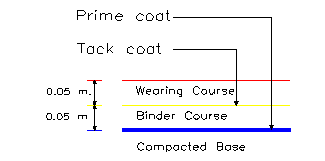
Profile of a multilayered asphalt concrete pavement
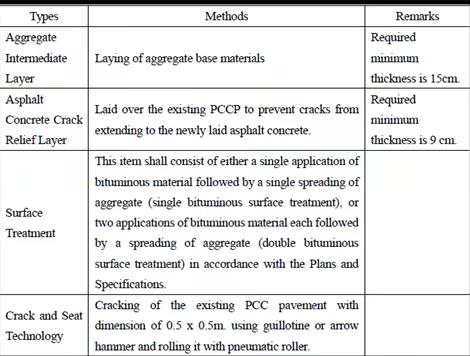
Asphalt Concrete overlay on PCCP
4.4.1. Common defects of Asphalt Pavement:
1. Alligator cracking is a load associated structural failure. The failure can be due to weakness in the surface, base or sub grade; a surface or base that is too thin; poor drainage or the combination of all three. It often starts in the wheel path as longitudinal cracking and ends up as alligator cracking after severe distress.
FIX: Because a structural failure is taking place the only possible solution to alligator cracking is to perform a full-depth patch.
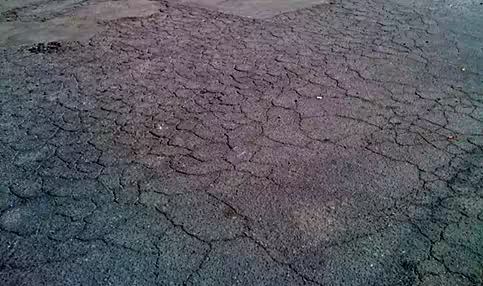
2. Block cracks look like large interconnected rectangles (roughly). Block cracking is not load-associated, but generally caused by shrinkage of the asphalt pavement due to an inability of asphalt binder to expand and contract with temperature cycles. This can be because the mix was mixed and placed too dry; Fine aggregate mix with low penetration asphalt & absorptive aggregates; poor choice of asphalt binder in the mix design; or aging dried out asphalt.
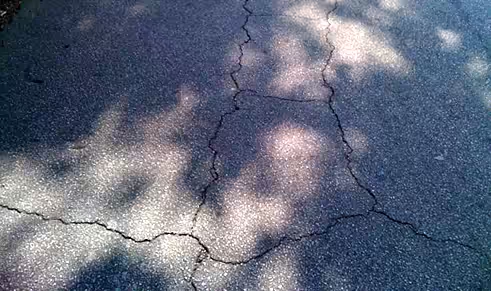
FIX: Less severe cracks measuring 1/2 inch or less can be sealed to prevent moisture from entering into the sub grade. More severe cracks should be fixed by removing the cracked pavement layer and replacing it with an overlay.
3. Longitudinal cracking are cracks that are parallel to the pavements centerline or laydown direction. These can be a result of both pavement fatigue, reflective cracking, and/or poor joint construction. Joints are generally the least dense areas of a pavement.
FIX: Less severe cracks measuring 1/2 inch or less can be sealed to prevent moisture from entering into the sub grade. More severe cracks should be fixed by removing the cracked pavement layer and replacing it with an overlay.
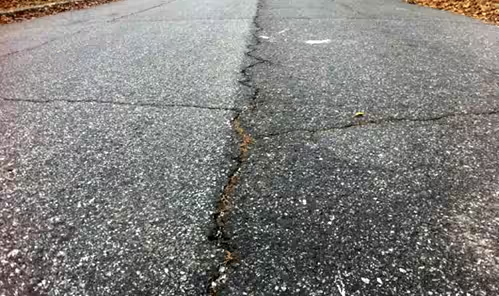
4.Transverse cracks are single cracks perpendicular to the pavement’s centerline or laydown direction. Transverse cracks can be caused by reflective cracks from an underlying layer, daily temperature cycles, and poor construction due to improper operation of the paver.
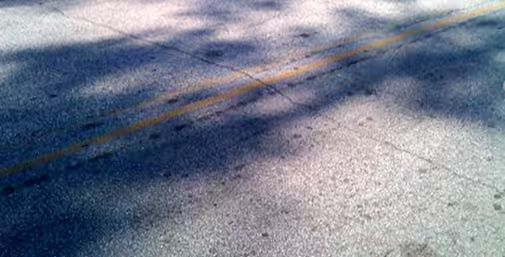
FIX: Less severe cracks measuring 1/2 inch or less can be sealed to prevent moisture from entering into the sub grade. More severe cracks should be fixed by removing the cracked pavement layer and replacing it with an overlay.
5. Edge Cracks travel along the inside edge of a pavement surface within one or two feet. The most common cause for this type of crack is poor drainage conditions and lack of support at the pavement edge. As a result underlying base materials settle and become weakened. Heavy vegetation along the pavement edge and heavy traffic can also be the instigator of edge cracking.
FIX: The first stepin correcting the problem is to remove any existing vegetation close to the edge of the pavement and fix any drainage problems. Crack seal/fill the cracks to prevent further deterioration or remove and reconstruct to full depth fixing any support issues.
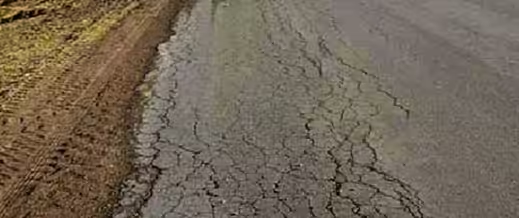
6. Joint Reflection Cracks are cracks in a flexible pavement overlay of a rigid pavement (i.e., asphalt over concrete). They occur directly over the underlying rigid pavement joints. Joint reflection cracking does not include reflection cracks that occur away from an underlying joint or from any other type of base (e.g., cement or lime stabilized).
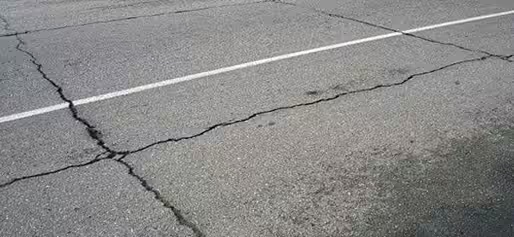
FIX: For less severe cracks (less than 1/2 inch) crack sealing will prevent the further entry of moisture into the subgrade. If the cracks are more severe the removal of the cracked pavement layer followed by an overlay may be required.
7. Slippage cracks are crescent-shaped cracks or tears in the surface layer(s) of asphalt where the new material has slipped over the underlying course. This problem is caused by a lack of bonding between layers. This is often because a tack coat was not used to develop a bond between the asphalt layers or because a prime coat was not used to bond the asphalt to the underlying stone base course. The lack of bond can be also caused by dirt, oil, or other contaminants preventing adhesion between the layers.
FIX: All of the areas exhibiting the “stretch marks” will need to be removed and will require a partial or full depth patch.
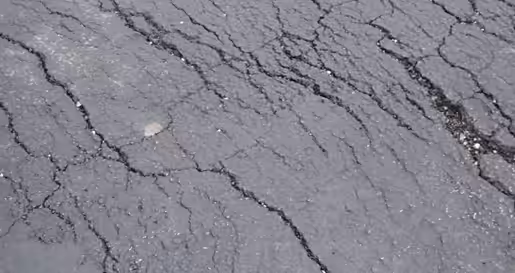
8. Pot Holes are small, bowl-shaped depressions in the pavement surface that penetrate all the way through the asphalt layer down to the base course. They generally have sharp edges and vertical sides near the top of the hole. Potholes are the result of moisture infiltration and usually the end result of untreated alligator cracking. As alligator cracking becomes severe, the interconnected cracks create small chunks of pavement, which can
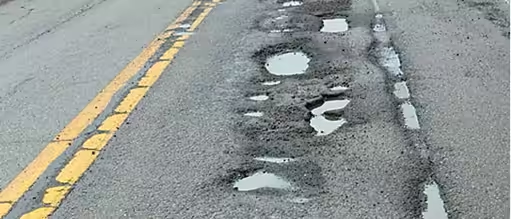
be dislodged as vehicles drive over them. The remaining hole after the pavement chunk is dislodged is called a pothole.
FIX: Full depth replacement patch.
9. Depressions (bird baths) are localized pavement surface areas with slightly lower elevations than the surrounding pavement. Depressions are very noticeable after a rain when they fill with water.
FIX: Depending on the severity of the depression the asphalt may have to be removed and replaced (severe). Less severe depressions can be fixed by applying a thin surface patch or infrared patch.
10. Ruts in asphalt pavements are channelized depressions in the wheel-tracks. Rutting results from consolidation or lateral movement of any of the pavement layers or the
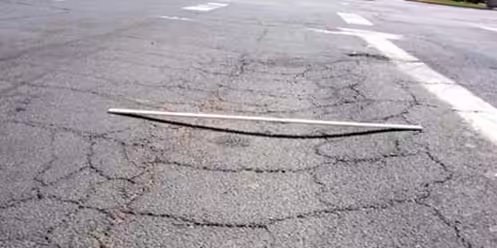
subgrade under traffic. It is caused by insufficient pavement thickness; lack of compaction of the asphalt, stone base or soil; weak asphalt mixes; or moisture infiltration.
FIX: If rutting is minor or if it has stabilized, the depressions can be filled and overlaid. If the deformations are severe, the rutted area should be removed and replaced with suitable material.
11. Shoving is the formation of ripples across a pavement. This characteristic shape is why this type of distress is sometimes called wash-boarding. Shoving occurs at locations having severe horizontal stresses, such as intersections. It is typically caused by: excess asphalt; too much fine aggregate; rounded aggregate; too soft an asphalt; or a weak granular base.
FIX: Partial or full depth patch
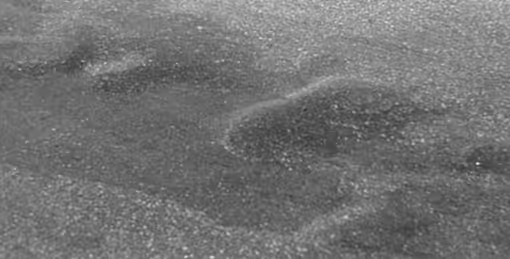
12. Upheaval is a localized upward movement in a pavement due to swelling of the subgrade. This can be due to expansive soils that swell due to moisture or frost heave (ice under the pavement).
FIX: Full depth patch
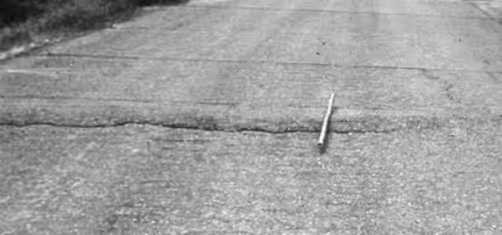
13. Raveling is the on-going separation of aggregate particles in a pavement from the surface downward or from the edges inward. Usually, the fine aggregate wears away first and then leaves little “pock marks” on the pavement surface. As the erosion continues, larger and larger particles are broken free and the pavement soon has the rough and jagged appearance typical of surface erosion.
FIX: Apply a thin hot-mix overlay. Other solutions could include: sand seal, chip seal, slurry seal or micro-surfacing.