
2.2. Conduct a Risk Analysis
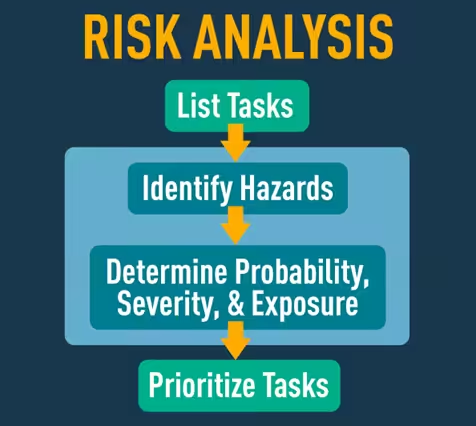
- Once you have identified tasks you believe might require a JHA, it’s important to prioritize each task. To do this, analyze each task to determine their degree of risk. To determine the degree of risk objectively, it’s important to know what risk is, so let’s discuss the concept next.
- Image are the steps in a RISK analysis
Risk = Probability x Severity x Exposure
Probability describes the likelihood that a worker will be injured or become ill if exposed to a hazard.
Common terms used to describe probability:
•Unlikely – Injury from exposure has low probability.
Less than 50% chance.
•Likely – Injury from exposure has moderate probability.
50/50 Chance.
•Very likely – Injury from exposure has high probability.
Greater than 50% chance.
The overall risk inherent in a job is a function of three variables: probability, severity and duration. The greater the probability, severity and exposure – the higher the risk while doing a job.
Severity is an estimate of how serious the injury or illness will be as a result of an accident. The severity of an injury or illness for any given exposure is largely fortuitous: it’s a matter of chance or luck. For instance someone could fall from a plan and live to tell about it. It’s not the fall, it’s the nature of the sudden impact and orientation of the body that determines the severity of the injury.
Common terms used to describe severity:
•Minor – other than serious physical harm that does not prevent the employee from continuing to work in the same job
•Serious – serious physical harm that prevents the employee continuing to work in the same job
•Death – fatality
Exposure is the condition of being exposed to hazard such that the employee is somehow affected by that hazard.
Physical Exposure can be thought of as “arms length” exposure to physical hazards. Exposure can be much farther than arms length if some kind of biological hazard exists.
If the employee can get injured or ill as a result of proximity to a danger zone, physical exposure exists.
Environmental exposure occurs when the employee can suffer some kind of injury or illness as a result of a hazardous environment. Distance does not matter. For instance, an employee may suffer hearing loss as a result of working near loud continuous noise sources.
Factors that increase RISK
There are many factors that may increase the probability and severity of an accident. You may need to be able to discuss the factors that you considered if someone wants you to justify the particular level of risk at which you arrived. Some of these factors include:
- The number of employees exposed to hazards
- The experience level of employees exposed to hazards
- The number of hazards in the procedure
- The number of opportunities for unsafe behaviors
- The frequency of exposure to hazards
- The employee’s belief about the hazards
- The duration of exposure to specific hazards
- The proximity of employees to the point of danger
- The complexity of the procedure
- Potential severity of the injury or illness when exposed
- Unreasonable workload (physically/mentally incapable of meeting expectations)
- Working under distress (hurry, fatigue, illness, personal problems)
RISK Assessment Matrix
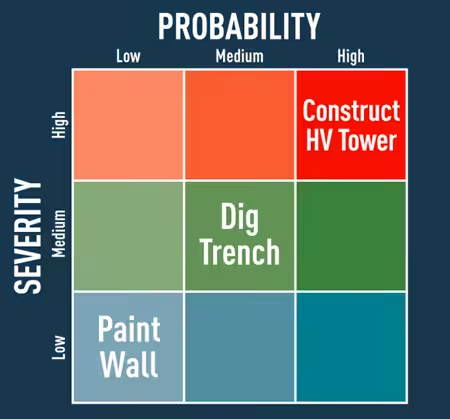
A simple technique to help determine the overall risk of the jobs for which you’ll be conducting a JHA. It is a simple process to determine the risk level of each job:
- List all of the jobs that you are analyzing.
- Estimate the probability and severity of each job.
- Place the task in the appropriate section of the risk matrix.
Once you’ve entered all tasks, you can easily prioritize each job to determine which jobs to analyze first.
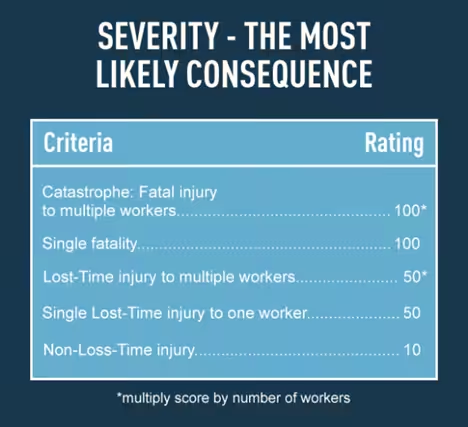
To more precisely determine risk, you may want to use numerical values like those described in the tables below. Quantifying risk helps justify how you’ve prioritized jobs.
Using the two tables above you can develop “risk scores” to indicate the degree of risk in each job.
For example, a job in which exposure to a danger zone is likely to result in an injury or illness would receive a Probability Score of “6” from the table.
In this case, a job in which exposure might result in a lost time injury to one worker would receive a Severity Score of “50”.
Risk = Probability (6) x Severity (50) x Exposure (1) = 300
If more than one employee is exposed while performing the task, you would multiply the Probability/Severity Scores total by the number of employees.
In this case, let’s say two employees are working together on the job. Both are equally exposed. Using the formula below:
Risk = Probability (6) x Severity (50) x Exposure (2) = 600