6.2 Lighting System
A lighting system is defined as all of the components necessary to meet a requirement for illumination. This includes all components from the switch that controls the power to the lamps all the way to the reflectance of the space in which the lighting system operates.
The first consideration when examining lighting systems for energy savings opportunities must always be the requirement for illumination, defined by:
- The duration of illumination required and,
- The level of illumination required.
While significant savings may be achieved through modifications to lighting systems, inappropriate actions can have a far more dramatic effect on worker and occupant productivity and comfort.
The following questions examine a lighting system primarily from the perspective of the requirement:
- Are lights on when the space is unoccupied?
This may be due in part to a lack of switching, say in a large open space. Also occupants may not be fully aware of the value in switching off lights upon leaving.
- Are lights on in an area served by daylight?
Again a lack of switching may prevent occupants from turning off lighting when daylight is sufficient. If curtains have been closed to avoid daylight it may be that glare problems exist. Daylight may not always be appropriate.
- Is lighting switched from breakers?
Breakers were not designed for frequent switching and typically will only allow switching of large areas resulting in lighting in local unoccupied areas.
- Is there sufficient and convenient switching available?
Occupants may not be able to conveniently control lighting.
- Is the level of light appropriate for the task at hand?
This may suggest a reduction in significantly over-lit areas which offers an energy savings opportunity. But, it may also suggest an increase in lighting which while consuming more energy could yield comfort and productivity benefits. If changes are to increase/decrease illumination levels, then this is the best time to consider other changes to the system including more efficient light sources.
- Is regular maintenance performed?
A dirty lighting system will not deliver as much light as a clean one. This may reduce light levels to unacceptable levels or result in installation/use of more lighting and hence more energy consumption. A clean fixture is an efficient fixture. If the fixture is chronically dirty it may be that it is not appropriate for the type of environment in which it is installed.
There are several options available to improve the match of requirement to usage of the lighting system including:
- Provide more levels of switching
Switches that control too large an area can result in unnecessary illumination of unoccupied spaces. Consider re-wiring and adding switch control that is appropriate to the patterns of use of the space.
- Use time clocks and/or photocells on outdoor lights
Outdoor lighting should almost always be automatically controlled; otherwise, it tends to be overlooked.
- Use motion sensors to switch lights
Motion sensors work well in areas that are limited in size, and have irregular occupancy patterns.
- Use timer switches to control lights
A good application of timers would be in a warehouse in which occupants are present infrequently, or possibly small washrooms where lights (and fans) tend to be forgotten.
- Use photocell switching on window fixtures
Photocells can be used to switch off a row of lights near a window when the amount of
light from outside is sufficient for the activity in the space. Care should be taken to avoid
glare when utilizing window light.
- Use task lighting & turn off overhead lights
Using overhead lighting to illuminate very localized tasks is not optimal. Overhead
lighting can be reduced to minimum levels for safety (access), and task lighting can be
used with levels specific to each task. A desk lamp is a good example of task lighting.
Finally, the following opportunities address the efficiency of the light source and delivery
system:
- Use most appropriate design and maintenance
Re-consider the overall design of the lighting system present. This should involve
performing illumination level calculations, and consideration of the number, position, type
and maintenance of fixtures.
- Convert to a more efficient light source
Often converting from one source to another will yield the same illumination level for a
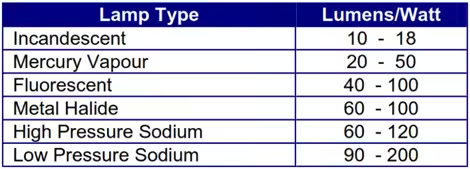
fraction of the energy cost. Consider the sources listed in Table 1 and the relative light
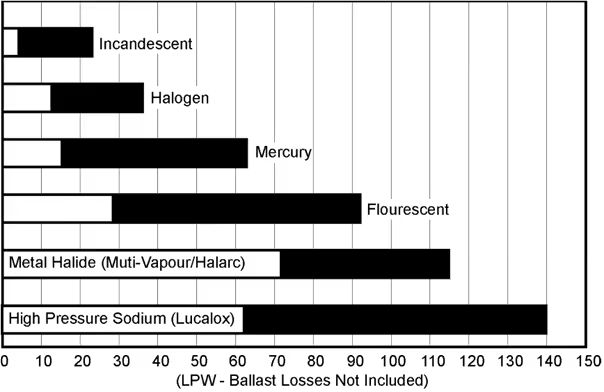
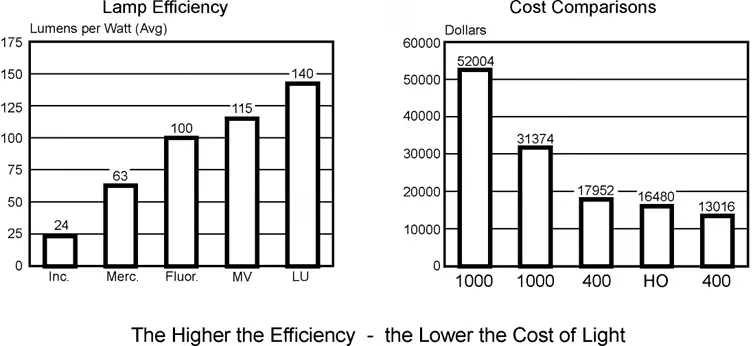
efficiencies – correctly called efficacies. Figure 1 presents the same information
graphically. As part of the above design analysis, consideration of the light source
efficiency could be made.
6.2.1. Meeting the Need
The lighting system must be designed and operated to meet the need for illumination at
the lowest expenditure of energy. Lighting levels that are considered appropriate for
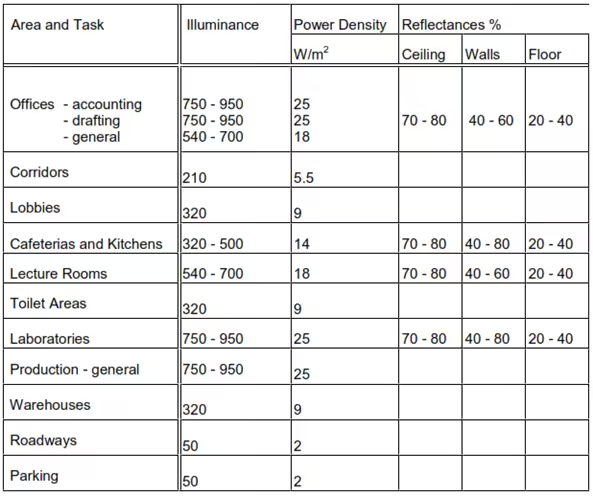
various building locations and functions are summarized in Table 2.
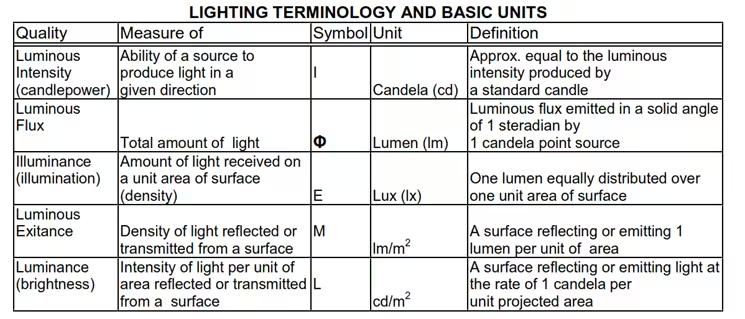
- Color Rendering Index: CRI is a unit of measure that defines how well colors are rendered by different illumination conditions in comparison to a standard (i.e. a thermal radiator or daylight). CRI is calculated on a scale from 1-100 where a CRI of 100 would represent that all color samples illuminated by a light source in question, would appear to have the same color as those same samples illuminated by a reference source. To put it another way, low CRI causes colors to appear washed out and perhaps even take on a different hue, and high CRI makes all colors look natural and vibrant.
Table 1 Light Source Efficacy
- Color Temperature describes certain color characteristics of light sources. A “blackbody” is a theoretical object which is a perfect radiator of visible light. As the actual temperature of this blackbody is raised, it radiates energy in the visible range, first red, changing to orange, white, and finally bluish white.
Figure 1 Lamp Efficacy (Lumens per Watt -LPW)
Color temperature describes the color of a light source by comparing it to the color of a blackbody radiator at a given temperature. For example, the color appearance of a halogen lamp is similar to a blackbody radiator heated to about 3000 degrees Kelvin. Therefore, it is said that the halogen lamp has a color temperature of 3000 degrees K- which is considered to be a warm color temperature.
Though color temperature is not a measure of the physical temperature of the light source, it does correspond to the physical temperature of the blackbody radiator when the color appearance is the same as the source being tested.
Table 2
Recommended Illuminance Levels, Power Densities and Surface Reflectances
6.2.2. Alternative Light Sources
The characteristics of various commonly used light sources are summarized in Table 3.
Table 3
Comparison of Typical Light Source Characteristics
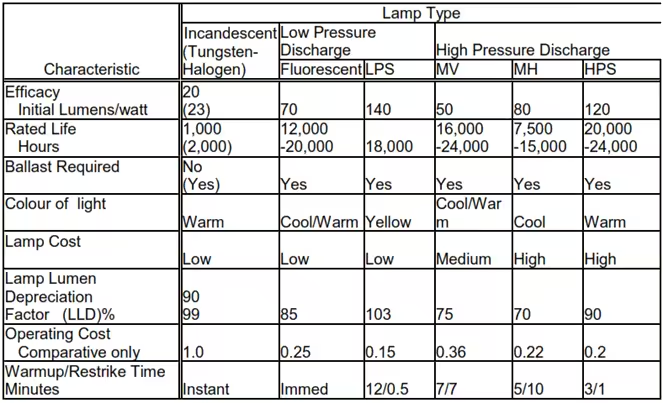
Figure 2
Efficiency vs Cost
6.2.3 Fluorescent Lamps
The fluorescent lamp is by far the most common light source used in buildings. It is a tubular, low-pressure discharge lamp containing small amounts of mercury. The fill gas is argon. The lamp tube is coated on the inside with phosphor. In operation, ultraviolet radiation resulting from luminescence of the mercury vapor due to a gas discharge is converted to visible light by the phosphor. As with all gas discharge lamps a ballast is needed to aid starting and to sustain operation. As a linear lamp with a large surface area, its brightness is comparatively low and its potential for discomfort and glare is low. Principal applications are office and industrial interiors and utility areas in the home. Fluorescent lamps are most commonly made with glass tubular bulbs varying in diameter from 16 mm (.62 inches) to 54 mm (2 inches) and in overall length from 150 to 2440 mm (6 to 96 inches).
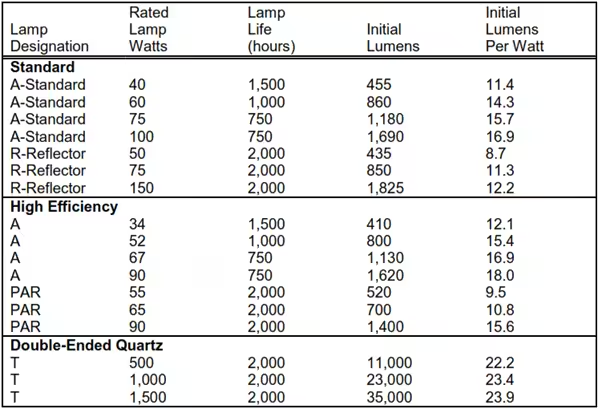
Table 4
Characteristics of Incandescent Lamps
The fluorescent bulb is historically denoted by a letter, denoting its shape, and a number, indicating its diameter in multiples of 1/8 inch. Thus T12 is a 1½ inch diameter tube. Other letter codes include C (circular) and U (u-shaped).
Electrodes, hermetically sealed into the bulb, one at each end, are designed to operate on either a glow or a discharge mode, and are referred to as “cold” and “hot” cathodes respectively. The “hot” cathode design results in a more efficient lamp operation, with the result that most fluorescent lamps are designed for this mode of operation. Typically, the luminous efficacy or light output in lumens per watt for a T12 fluorescent lamp is in the order of 60 lumens/W. This represents a power conversion efficiency of 10%. The operation of a fluorescent lamp is controlled by a ballast which is connected in series with the lamp. The ballast provides the required starting and operating voltages and limits the lamp current after the arc has developed (the lamp, in common with all discharge lamps has a negative volts-amp characteristic).
High Output Fluorescent Lamps
Fluorescent lamps are further classified by their operating current, i.e. the current that flows through the lamp, not the current taken from the supply. Standard lamps operate at 430mA, High Output (HO) lamps operate at 800mA, and Very High Output lamps operate at 1500mA.
Rated Life of Fluorescent Lamps
The rated life of a fluorescent lamp is a median value of life expectancy. It is normally defined as the total operating hours at which, under a three-hour operating cycle, 50% of a large number of installed lamps would be expected to be still burning. Typically, this will range from 7,500 to 20,000 hours. The burning life of a “hot” cathode lamp is a factor of the rate of loss of the electrons from the cathode. This occurs during starting and operation. The shorter the burning cycle the shorter the burning life. For example, a lamp operated continuously can be expected to burn almost twice as long as a similar lamp operated for only three hours per start. This fact has given rise to the belief that fluorescent lamps should not be switched off for short periods of time as the resulting lamp life loss will be more that the cost of saved energy. In general, switching a fluorescent lamp off for even 10 minutes will usually be cost effective. The life of a “cold” cathode lamp is not similarly affected.
Ballast and starter characteristics are also a key factor in the operational life of preheat started lamps. Ballasts which do not provide correct starting or operating voltages can greatly affect lamp life.
Proper heating of rapid start lamp electrodes is a critical factor. Poor lamp to lamp holder contact or incorrect wiring can result in little or no electrode heating. Lamps operating in this mode will fail prematurely, say after 50 to 500 burning hours.
Effects of Voltage Variations
Line voltage, whether too high or too low, will also adversely affect lamp life. Low voltage can cause starting problems which can seriously deteriorate the electrodes. Voltages above normal cause excessive lamp operating currents leading to premature lamp failure and overheating of the ballasts. Generally, supply voltages should be maintained within a ± 5% of rated voltage of the ballast.
Energy-Saving Lamps and Ballasts
Energy saving fluorescent lamps are available in most sizes and color for rapid start, preheat and instant start fixtures. They are lower wattage, in the order of 12% than the equivalent standard lamp but are nearly equal in light output.
Energy saving ballasts are also available; High Efficiency and Electronic Rapid and Instant Start. Savings in energy using electronic ballasts can be as much as 25%. Fluorescent lamps controlled by electronic ballast operating at high frequency, 20 kHz, are 10% more efficient. Electronic control starters are also available for preheat starting. Although up to 25 times more expensive, electronic starters last longer and start lamps without flicker, thus extending lamp life.
Retrofitting energy efficient ballasts is not a good investment because of the relatively high initial cost, but their use in new installations should be seriously considered. Relamping with energy saving lamps may be more attractive depending on your energy and lamp costs.
Compact Fluorescent Lamps
Compact fluorescent lamps are available from various manufacturers as replacement for incandescent lamps up to 100W. The lamps, complete with electronic ballasts, are designed to be used in the lamp holder of the incandescent lamp to be replaced, with no modifications required.
Typical compact fluorescent lamps with their wattage and equivalent incandescent lamp wattage are shown in Table 4. Although more expensive (up to 20 times) they consume less than 25% the energy for the same light output and last up to 10 times as long.
Table 4
Characteristics of Fluorescent Lamps
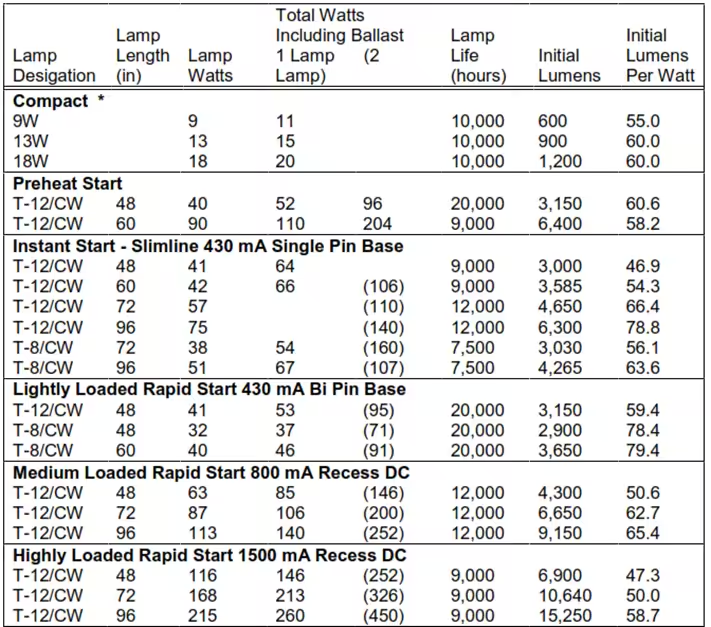
13W replaces Standard A 60W
18W replaces Standard A 75W
6.2.4. Low Pressure Sodium (LPS) Lamps
The LPS lamp is the most efficient light source presently available, although its quality severely limits its applications in buildings. The LPS is a discharge lamp where the arc is carried through vaporized sodium, producing the characteristic yellow sodium light color. Lamp shape is a single ended tubular, containing a U-shaped arc tube. Unlike other light sources, LPS lamp wattage rises with use to approximately 3% above initial value at rated life. This is coupled with an increase in light output of approximately 5% above initial. As a result, the LPS lamp is able to maintain fairly uniform output during its life. The monochromatic yellow characteristic of LPS renders all colors to appear yellow or as shades of brown. It is most suitable for outdoor area and security lighting.
6.2.5. High Intensity Discharge (HID) Lamps
The mercury vapor (MV) lamp is the original point source discharge lamp in which the arc is struck through mercury vapor to produce visible as well as ultraviolet light. Operating pressures of HID lamps are in the order of 1 to 10 atmospheres. Lamps are constructed with two bulbs, an inner bulb of quartz which contains the arc, and an outer bulb to shield the arc tube from temperature variations and to filter out the UV radiation. It is important to ensure that the outer bulb is intact to keep people from the dangers of exposure to UV radiation. Lamps are available that automatically switch off when the outer bulb is broken. The light color of the clear mercury lamp is predominantly greenish-blue and not very flattering to complexions. Phosphor coated or color improved mercury lamps correct this by producing a warmer color effect for indoor applications. The lamp is started by a separate electrode/resistor circuit in the lamp. Starting takes up to 3 minutes. As with all HID lamps a serious voltage dip lasting only a few cycles, or loss of supply for only ½ cycle will cause the lamp to go out. The lamp must cool down and the gas pressure drop, a period of up to 7 minutes before it will restrike. MV has been superseded in efficiency and color quality by other lamps in the HID family. Users are well advised to consider metal halide and/or high pressure sodium types as more efficient alternatives to MV.
6.2.6. Metal Halide (MH) Lamps
The MH lamp is an improved version of the mercury lamp where additive iodine compounds are present in the arc tube to produce a whiter color light at a higher efficacy than MV. Rated life of this lamp is typically 15,000 hours at present but, with continuing improvements in design, is expected to increase towards the 24,000 hour rating typical with the other HID sources. Standard MH lamps require different ballasts from MV types. Most lamp manufacturers, however, have special MH lamps that will work on specific types of MV ballasts. The “white” light produced by Metal Halide lamps make them the choice for sports fields and architectural lighting, and for color sensitive industrial processes. The lamp warms up and restrike time of up to 10 minutes is a major disadvantage. Double ended lights are available, designed for sport lighting, that can be restruck instantaneously by application of a high voltage spike, 20,000 volts, to the starting electrode.
6.2.7. High Pressure Sodium (HPS) Lamps
HPS lamps utilize a ceramic arc tube containing sodium, mercury and xenon gas. The HPS ballast differs from other HID ballasts in that starting is accomplished by a high voltage pulse. The arc tube of the HPS lamp is too small to accommodate a separate starting electrode. The xenon gas acts as a starting gas and as the arc tube heats up, the mercury and sodium vaporize to produce the golden-white discharge. Restrike time with the high voltage pulse is about one minute. Restrike can be achieved instantaneously by applying a 40,000-volt spike. Less expensive solutions incorporate a quartz incandescent lamp or a second arc tube in the same glass envelope. Principle applications are in roadways, area and industrial lighting. However, HPS can also be used in non-color sensitive areas, such as warehouses and gymnasiums. Generally, HPS lamps cannot be used with MV or MH ballasts.
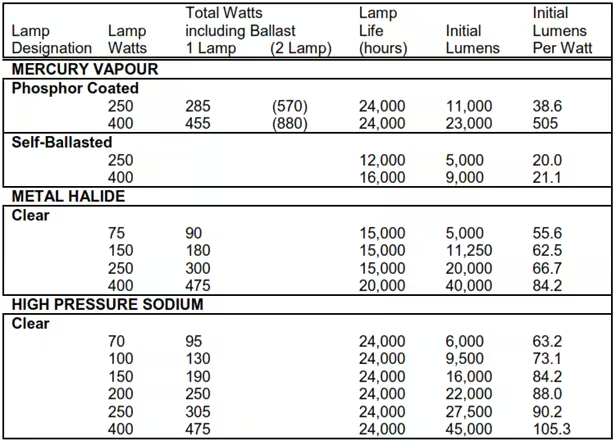
Table 5
Characteristics of High Pressure Discharge Lamps
6.2.8. Energy Management Opportunities – Lighting
- Switch off Unnecessary Light
Switch off lights in unoccupied areas, and in areas where daylight provides adequate lighting levels. Switching can be done manually or by automatic control. Manual switching can be facilitated by providing light switches at strategic points. Automatic controls include photo cells, occupation sensors and time switches. Perhaps the cheapest solution is to delegate the responsibility for switching off lights to operating and security staff.
- Remove Redundant Fixtures
Many plants undergo modifications and reorganization. Areas are redesignated and equipment moved but the lighting system is not correspondingly updated, with the result that lights may become redundant. An example of this is where a new office has been built within an existing covered area. The original lighting over the new office becomes redundant and should be removed. Energy and lamp costs are reduced, and the removed fixtures can be reused.
- Fixture Delamping
This measure simply entails removing selected lamps from existing light fixtures. Either lamps are removed in a uniform pattern throughout specific areas to reduce overall lighting or selected lights that do not contribute to task or safety lighting are removed. Fluorescent fixtures generally have two lamps operating on a common ballast. Removal of one lamp will cause the other lamp to extinguish. Either both lamps should be removed or one lamp replaced by a dummy tube. In the former case the fixture should be disconnected from the supply as the ballast will continue to consume power, at approximately 15% of the lamp wattage. Dummy tubes are available at approximately the same cost as standard lamps. In areas where lamps have burnt out and productionhas not been adversely affected, delamping should be implemented as soon as possible.
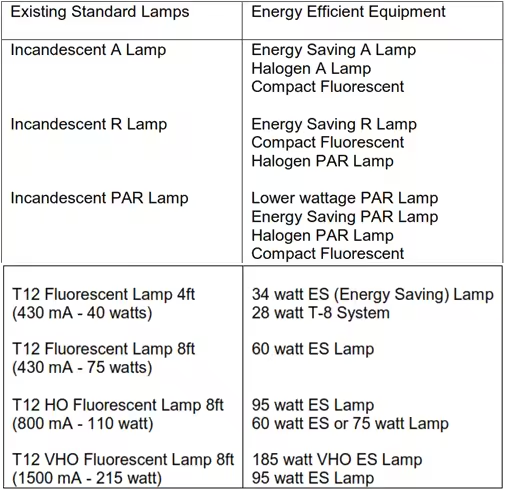
- Fixture Relamping
Fixture relamping is the replacement of an existing lamp with a new more efficient light source. Fixture relamping will involve more initial cost than delamping.
Examples of relamping:
Fixture Modifications or Replacement
Fixture modifications cover a wide range of techniques which may be implemented to improve existing lighting systems:
- Remove Or Replace Fixture Lenses
Lighting levels can be increased by removing fixture lenses. In bigger areas in excess of 16 m2 resulting glare may be a problem. In such cases the lens could be cleaned or replaced.
- Retrofit the Existing Lighting System with A More Efficient System
Replace outdoor tungsten halogen lights with high pressure sodium, or indoor mercury vapor lights with high pressure sodium.
- Replace Inefficient Ballasts
This measure is usually only cost effective if the existing ballast has burnt out.
Cleaning Light Fixtures, Lamp Reflectors and Room Surfaces
Although regular maintenance may not directly save energy costs, the lighting system will be more efficient and effective. Depending on the environment, lamps and reflectors should be cleaned every 1½ – 3 years for open fixtures. Fixture lenses should be cleaned every ½ – 1½ years. Regular cleaning can reduce light loss by up to 30%. By maintaining room reflectances light loss can be further reduced by an additional 10%. A regular maintenance program should be instigated before any other energy conservation measures are considered.
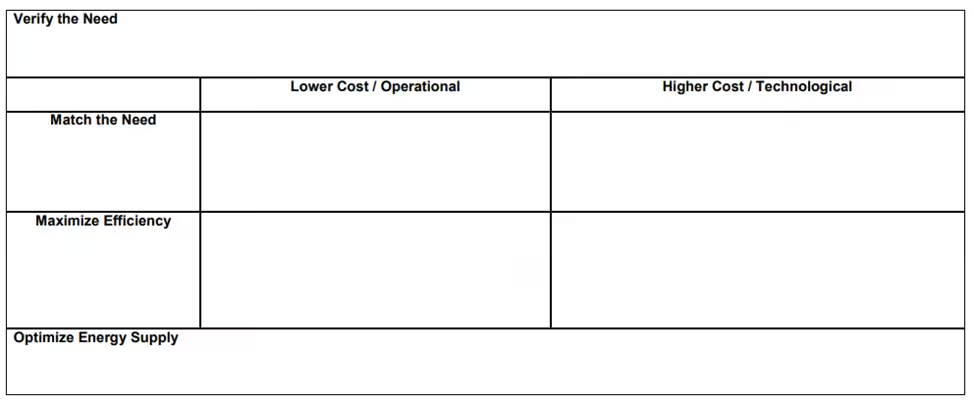
6.2.9. Worksheet 1. Lighting System Opportunities
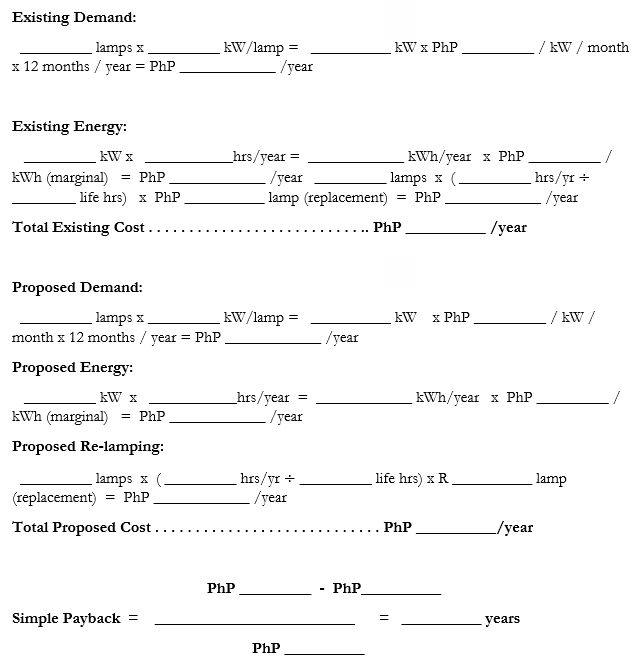
6.2.10. Worksheet 2. Lighting System Retrofit Savings Calculations